
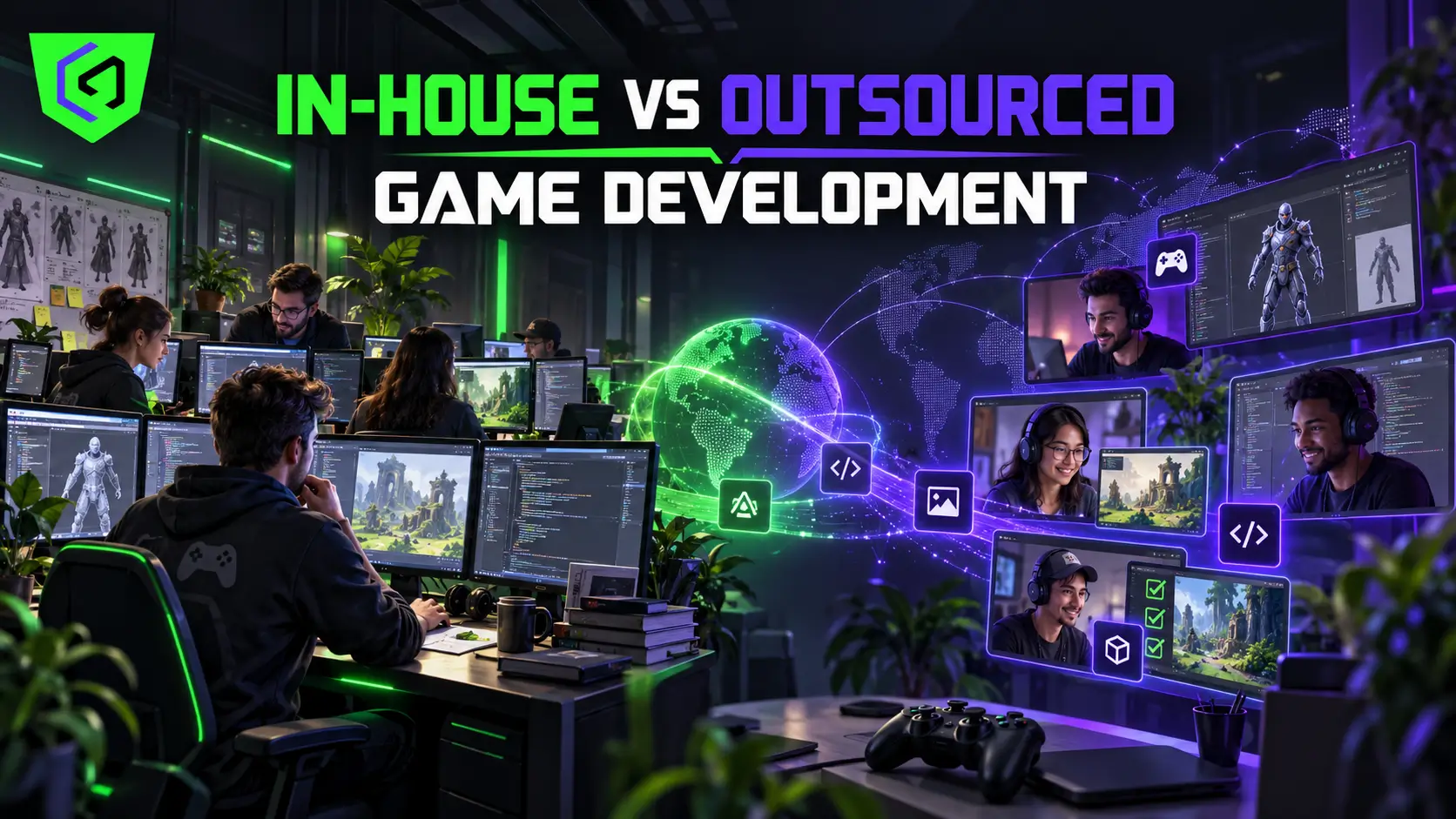
Somewhere right now, a founder is staring at a spreadsheet with two columns and no good answer in either one: hire a full internal team and watch runway evaporate before a single build is playable, or hand the project to strangers and hope the studio they picked actually knows what it is doing. That tension is exactly why game development outsourcing has become such a central conversation in modern production planning rather than a niche cost-cutting tactic reserved for cash-strapped indies.
The global game development outsourcing market was valued at 2.21 billion dollars in 2026 and is projected to reach 7.23 billion dollars by 2035; a recent industry survey found that engineering work specifically jumped from 10 percent to 34 percent of externally sourced production services in a single year. This guide breaks down when in-house game development actually makes sense, when it does not, and how to make the call without guessing.
What Does In-House Game Development Actually Mean?
In-house game development means building and staffing an internal team, engineers, artists, designers, and QA, that works exclusively on a studio’s own projects under direct management. Every hire is a full-time employee, every tool and pipeline decision stays entirely within the studio’s control, and every piece of institutional knowledge accumulates internally rather than sitting with a vendor who might work with a competitor next quarter.
That control comes at a real cost, and it is worth stating plainly rather than glossing over. A twenty-person internal team typically runs somewhere between 2.4 million and 4.8 million dollars annually once salaries, benefits, equipment, and overhead are all counted, and that cost keeps running through every gap between projects, every slow quarter, and every period where the pipeline simply is not full. Building that team from scratch also takes months, since sourcing, interviewing, and onboarding senior engineers and artists is rarely a fast process even with a healthy hiring budget behind it.
What Does Outsourcing Game Development Actually Involve?
Choosing to outsource game development means hiring an external studio or team of external game developers to handle part or all of a project’s production, from a single discipline like environment art to an entire full-cycle build managed end to end by a dedicated partner. The scope is flexible by design, and most engagements fall somewhere between those two extremes rather than at either pole.
The financial case for this model is substantial and well documented across current industry data. Studios working with an established outsourcing partner typically see cost reductions of 40 to 60 percent compared to building equivalent in-house capacity, largely driven by regional rate differences and the elimination of the fixed overhead that comes with full-time staff. A full mobile game build through a reputable outsourcing partner commonly runs between 20,000 and 250,000 dollars depending on scope, a figure that looks almost impossibly small next to the annual cost of a twenty-person internal team, precisely because it is scoped to a single project rather than a standing department.
The Real Tradeoffs Between the Two Models
Speed favors outsourcing in almost every comparison that matters to a founder watching a runway clock. A vetted outsourcing partner can typically deploy a scoped team within days, while sourcing and onboarding senior in-house hires realistically takes three to five months even in a strong hiring market. For a studio racing toward a specific launch window or trying to capitalize on a narrow market opportunity, that difference alone can decide whether a project ships on time or misses its moment entirely.
Control favors keeping a team internal just as clearly. Daily oversight, immediate course correction, and institutional knowledge that stays inside the building all come standard with an internal team in a way that no outsourcing arrangement, however well managed, can fully replicate. A studio building a long-running live-service title with years of planned content ahead of it often finds that the compounding value of an internal team’s accumulated knowledge eventually outweighs the cost savings outsourcing would have offered on any single project.
Flexibility tends to favor outsourcing for studios with uneven or unpredictable workloads. An external partner can scale a team up for a content-heavy production phase and scale back down once that phase ends, without a studio managing layoffs or carrying idle payroll through the inevitable quiet stretch between major releases. An in-house team, by contrast, is a fixed cost regardless of whether there is a full pipeline of work to justify it in any given month.
When Keeping Development In-House Genuinely Wins?
A studio with a long-term, multi-title roadmap and the funding to support it benefits enormously from building institutional knowledge internally rather than repeatedly onboarding new external partners for each new project. Live-service games with years of planned content ahead of them are a particularly strong fit for this model, since the compounding value of a team that deeply understands the game’s systems, codebase, and community tends to outweigh what outsourcing would save on any individual content update.
A studio building deeply proprietary technology, a custom engine, a novel rendering technique, or core intellectual property that represents the entire competitive advantage of the business, also leans toward keeping that specific work in-house regardless of cost, since the risk of that knowledge sitting with a game development studio partner can outweigh any savings on the table.
When Outsourcing Game Development Is the Smarter Call?
A studio building its first title, with no existing team and no certainty yet about whether the concept will find an audience, typically benefits from outsourcing rather than committing to the fixed cost of full-time hires before the product itself has proven anything. First-time founders in particular tend to underestimate how much runway a premature in-house team consumes before a single dollar of revenue exists to justify it.
Studios with a specific, well-defined gap, needing 3D character design and modeling for one title, or QA support during a single crunch period, also fit the outsourcing model well, since a defined scope of work rarely justifies the overhead of a permanent internal hire. Cobweb Games’ game development practice runs both full outsourced production and targeted discipline-specific engagements, which lets a studio scope exactly the support a project needs rather than choosing between an all-or-nothing commitment.
The Hybrid Model Most Studios Actually Land On
Very few successful studios operate as purely in-house or purely outsourced organizations once they reach any meaningful scale. The more common pattern keeps a lean internal core focused on creative direction, core systems, and community management, while outsourcing execution-heavy work like art production, QA, porting, and live operations to external partners who already have the pipelines built for exactly that kind of work.
This hybrid structure captures much of what makes each model appealing without fully committing to either one’s downsides. The internal team retains creative control and institutional memory over what matters most to the studio’s identity, while the outsourced components flex up and down with actual production demand instead of sitting as a fixed cost regardless of workload. Studios evaluating this path should treat the decision of what to keep internal and what to hand to a game development studio partner as a deliberate strategic choice rather than an afterthought decided project by project without a consistent underlying logic.
What a Real Vendor Evaluation Actually Looks Like
Studios that decide to outsource game development for the first time often stumble less on the decision itself and more on how they choose a partner once they have made it. A genuine evaluation starts with a portfolio review focused specifically on projects of comparable scope and genre, since a studio that has only ever delivered simple mobile puzzle games is not automatically equipped to handle a combat-heavy 3D action title, regardless of how polished their existing work looks in a pitch deck.
Communication rhythm deserves just as much scrutiny as technical skill. A team of external game developers spread across a wide time zone gap can still work brilliantly if response times are fast and documentation is thorough, but the same time difference paired with slow, vague communication turns every revision request into a multi-day delay that compounds across an entire production schedule. Asking a potential partner directly how they structure feedback loops, milestone check-ins, and escalation paths for urgent issues reveals far more about day-to-day reality than any polished sales call ever will.
A trial engagement before committing to full production scope is the single most protective step a studio can take here. A small, clearly scoped pilot project, a handful of assets, a short feature implementation, lets both sides confirm technical fit, communication style, and quality standards before either party commits real budget to a larger relationship. Studios that skip this step and jump straight to a full contract are effectively betting an entire production budget on a first impression, which is a considerably riskier wager than the short delay a proper trial phase adds to the front of a project.
Real Scenarios That Make the Decision Concrete
A solo founder with a validated concept and eighteen months of runway is almost always better served choosing to outsource game development for the initial build rather than spending the first six months of that runway just hiring a team, since every month spent recruiting is a month not spent building or testing whether the concept resonates with actual players. The math here is not close: a full outsourced mobile build can realistically launch inside that same eighteen-month window with runway left over for marketing and iteration, while an in-house-first approach often burns through half the available time before writing a single line of gameplay code.
A publisher with three live titles generating steady revenue and a fourth in active development sits in a very different position. That studio likely benefits from a lean internal core managing the shared technology and creative direction across all four titles, while outsourcing content production, localization, and platform ports to a game development studio partner who can flex capacity up during a content push and back down between them. Neither scenario has a universally correct answer independent of context, which is exactly why a framework beats a rule of thumb every time this decision comes up.
How to Decide: A Practical Framework
Start by mapping out actual project cadence over the next eighteen to twenty-four months. A studio with a steady, predictable pipeline of similar-scope projects can justify the fixed cost of an in-house team more easily than a studio uncertain whether its next project will even get greenlit. Next, identify which specific disciplines represent genuine competitive advantage versus which are purely execution work that any competent team could deliver to spec.
Finally, run the actual math rather than relying on general industry benchmarks alone. Get real quotes from potential outsourcing partners and compare them honestly against the fully loaded cost of equivalent in-house hires, including recruiting time, benefits, equipment, and the idle cost of that team during any gap between projects. The right answer is rarely obvious from general principles alone, and it changes meaningfully based on a studio’s specific project pipeline, funding runway, and how much of the work in question actually constitutes the studio’s core differentiator.
Frequently Asked Questions
Is outsourcing game development riskier than building in-house?
It carries different risks rather than simply more of them. In-house development carries execution and cost risk, since a full team has to be funded regardless of how a project performs. Outsourcing carries vendor and communication risk, which a thorough vetting process, clear contracts, and a trial engagement phase can substantially reduce before a studio commits to a larger scope.
How do I protect my intellectual property when working with external game developers?
A signed NDA before any project details are shared is standard practice, paired with a contract that explicitly transfers full ownership of all delivered assets and code to the client on final payment. Reputable outsourcing partners expect this and will not push back on reasonable IP protection terms.
Can I switch from outsourced to in-house development later, or is that too disruptive?
It is possible and reasonably common, particularly once a title proves successful enough to justify building a dedicated internal team around it. The transition works best when it happens at a natural project boundary rather than mid-production, since transferring an active codebase and pipeline knowledge mid-sprint adds unnecessary friction.
What is the difference between outsourcing a single discipline versus full-cycle outsourcing?
Single-discipline outsourcing covers one specific area, like art, animation, or QA, while an internal or separate team handles everything else. Full-cycle outsourcing hands an entire project, from concept through launch, to one external partner managing the whole production. The right choice depends on how much of a studio’s own capacity already exists internally.
Does game development outsourcing work for AAA-scale projects, or only smaller indie titles?
It works at both ends of the spectrum, though the specific vendors and engagement structures differ considerably. Major publishers routinely outsource significant portions of AAA productions, including entire platforms, ports, or content updates, to specialized external studios rather than staffing every discipline internally.
How long does it typically take to find and onboard a reliable outsourcing partner?
A proper vetting process, including reviewing past work, checking references, and running a small trial engagement, typically takes two to four weeks. That timeline is still dramatically faster than the three to five months a studio should expect when sourcing and onboarding equivalent senior in-house hires.
