
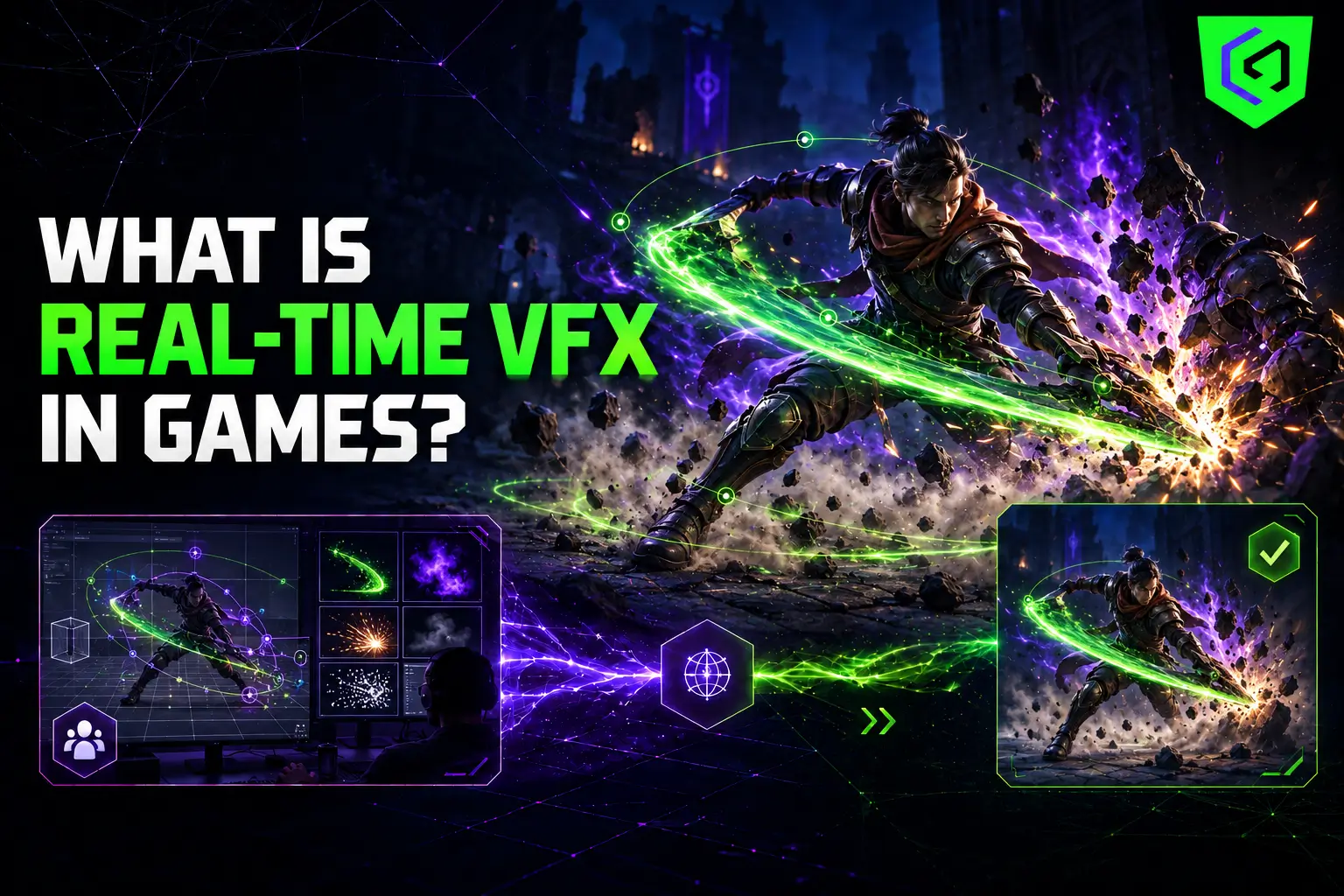
The explosion that rocks the screen when a grenade lands, the shimmer trailing a magic sword, the dust kicked up by a landing after a jump, none of that is pre-rendered footage waiting for its cue. It is calculated and drawn fresh every single frame, adjusting instantly to camera angle, player position, and whatever chaos is happening on screen at that exact moment. That is real-time VFX games rely on to make combat feel weighty and worlds feel alive, and it is a far more technically demanding discipline than most players ever stop to consider. This guide breaks down what the craft actually involves, how the major engines handle it differently, what a real production pipeline looks like, and what to expect from a genuine specialist in the field.
What Is Real-Time VFX in Games?
Real-time VFX in games refers to visual effects calculated and rendered live inside a game engine as the game runs, rather than pre-rendered in advance the way film effects typically are. It covers explosions, magic spells, weapon impacts, environmental effects like weather and fire, and the subtler feedback effects that confirm a hit landed or a button press registered. Every one of these effects has to run within a strict frame budget alongside everything else the engine is simultaneously calculating, which is the single constraint that separates this discipline most sharply from effects work done for film or animation.
This is where the phrase game visual effects earns its technical weight rather than functioning as a vague marketing term. A film VFX artist can spend hours of render time perfecting a single explosion. A game VFX artist has to build that same explosion to look convincing while costing a small enough slice of the frame budget that it does not tank performance the moment three of them go off simultaneously during a chaotic boss fight.
How Does Real-Time VFX Differ From Pre-Rendered Effects?
The core difference comes down to when the calculation happens. Pre-rendered effects for film get computed once, in advance, with essentially unlimited time per frame, then played back exactly the same way every time an audience watches. Real time VFX games use has to be calculated fresh every frame, responding to variables a film effect never has to account for: player camera angle, how many other effects are active simultaneously, current hardware load, and unpredictable player behavior that no storyboard could have anticipated in advance.
This live calculation requirement shapes every technical decision in the pipeline. An effect has to be authored with a performance budget in mind from the very first pass, not optimized as an afterthought once it already looks good. Particle counts, texture resolution, and shader complexity all get weighed against how many other systems are competing for the same frame time, and a genuinely skilled specialist develops an instinct for exactly where that budget line sits on a given project and platform.
The Core Categories of Game Visual Effects
Impact and combat effects cover hits, explosions, muzzle flashes, and the immediate visual feedback that confirms an action landed. These effects live or die on timing, since an impact effect that plays even a few frames out of sync with the actual hit registration reads as disconnected from the gameplay, no matter how good the effect looks in isolation.
Environmental effects bring a world to life through weather, fire, water, smoke, and the ambient particle systems that make a space feel physically real rather than static. Ability and spell effects, common in RPGs and action games, need to communicate function through appearance; a fire spell should visually read as different from an ice spell even at a glance, since players rely on that visual language to make split-second decisions during combat. UI and feedback effects round out the category, covering the subtler particle bursts, screen shakes, and glow effects that confirm a menu selection or a successful action without necessarily drawing conscious attention to themselves.
How Do the Two Major Engines Actually Compare?
Unity offers two distinct approaches to particle effects, and the choice between them matters considerably for project planning. Unity VFX built on the legacy Shuriken system runs on the CPU, supports all platforms including mobile, and handles simple to moderate effects reliably with a genuinely beginner-friendly workflow. Unity’s newer VFX Graph runs entirely on the GPU, supports particle counts well into six figures, and targets high-end PC and console work specifically, though its platform support is more limited and it demands a steeper learning curve than the older system.
Unreal VFX runs through Niagara, a node-based visual scripting system that supports both CPU and GPU simulation and can handle particle counts in the millions when running in full GPU mode. Niagara’s data-driven architecture makes it the standard choice for AAA productions and complex simulations where particle-to-particle interaction and maximum visual fidelity genuinely matter to the final product. The tradeoff is a steeper learning curve than Unity’s simpler Shuriken system, though the ceiling on what Niagara can achieve visually sits considerably higher.
Choosing between them ultimately comes down to project scope and platform target rather than one system being universally superior. A mobile game with broad device compatibility requirements leans naturally toward Unity’s CPU-based Shuriken system, while a AAA console title chasing maximum visual fidelity leans toward Niagara’s GPU-driven capabilities specifically.
What Does a Game VFX Artist Actually Do Day to Day?
A specialist in this discipline splits time between creative authoring and technical optimization in a way that few other art disciplines require in equal measure. Building an effect starts with reference gathering and concept exploration, the same creative process any visual artist would recognize, but every subsequent decision gets filtered through a performance lens that a concept illustrator never has to consider.
Shader work makes up a substantial portion of the job, since particle systems alone rarely produce a finished look without custom shaders controlling color, distortion, and how an effect interacts with lighting in the scene. Profiling and optimization consume real time too, using engine-specific tools to measure exactly how much frame budget an effect consumes and adjusting particle counts, texture resolution, or simulation complexity until the effect hits its target cost without losing the visual impact it was designed to deliver.
How Does the Real-Time VFX Production Pipeline Actually Work?
Production typically opens with reference gathering and a rough concept pass, establishing the visual language an effect needs to communicate before any technical work begins. A fire effect and an ice effect need to read as opposites at a glance, and that visual distinction gets locked conceptually before a single particle system gets built.
From there, the artist moves into building the actual particle system and any supporting shaders, iterating inside the engine itself rather than in a separate tool, since the effect has to be evaluated in the actual context it will run in. Profiling comes next, measuring the real cost of the effect on target hardware and adjusting until it fits the allotted budget. Integration and final testing confirm the effect syncs correctly with animation timing, gameplay triggers, and sound design, since a visually perfect effect that fires a few frames late still reads as broken to a player, regardless of how much polish went into the particle work itself. Cobweb Games builds this work as part of a broader game animation practice, since VFX timing depends so heavily on syncing cleanly with the character and combat animation happening around it.
Why Studios Bring In Outside Help for This Discipline?
Real-time VFX sits at an unusual intersection of art and engineering, which makes it one of the harder disciplines to staff internally for a studio without a dedicated effects department already in place. A generalist 3D artist can often produce convincing static renders without deep shader knowledge, but building particle effects and game visual effects that hold up under a strict frame budget requires technical fluency that a purely artistic background does not automatically provide.
This is why real-time VFX work often gets outsourced to specialists rather than assigned to whichever internal artist has the most spare capacity that month. A studio bringing in outside VFX support benefits from someone who already understands the specific tradeoffs between Shuriken, VFX Graph, and Niagara, rather than learning those tradeoffs for the first time on a live production with a launch date already set. Cobweb Games treats this discipline as a core part of its game animation services rather than a bolt-on specialty, since effects work has to stay synchronized with the same animation timing and combat feel the rest of the animation team is already building toward.
Bringing in a dedicated partner also helps studios avoid the common trap of treating particle effects as purely decorative. A skilled effects specialist thinks about readability and gameplay communication as much as visual spectacle, which is exactly the perspective a rushed internal assignment often lacks when a generalist artist is simply trying to make something look impressive rather than function correctly inside a real combat encounter.
Common Mistakes in Real-Time VFX Production
Building an effect without a performance budget in mind from the start is the most common and expensive mistake. An artist who perfects a beautiful, particle-heavy effect in isolation, only to discover during optimization that it needs to be gutted to hit a reasonable frame cost, has effectively done the work twice, once to build something unusable and again to build something that actually ships.
Ignoring readability in favor of pure spectacle causes real gameplay problems too. An effect so visually dense that it obscures whether an attack actually landed, or hides an incoming enemy projectile behind its own particle noise, actively works against the player rather than for them. Skipping cross-platform testing is another frequent issue, since an effect tuned and tested only on a high-end development machine can perform dramatically worse on the actual mid-range hardware most players own, sometimes badly enough to affect a game’s overall frame rate during heavy combat sequences.
What Does Professional Real-Time VFX Work Cost?
Pricing depends heavily on complexity, platform target, and whether the work involves custom shader development alongside the particle systems themselves. A simple impact or UI feedback effect can run a few hundred dollars, while a complex ability effect with custom shaders, multiple particle layers, and full platform optimization can run into the thousands per effect. Full effect libraries covering an entire game’s combat and environmental systems get quoted as a project package rather than per individual effect, since that structure gives both sides more predictable planning across a production that might need dozens or hundreds of distinct effects before launch. Studios building this work into a broader animation budget should evaluate it alongside their 2D animation and character animation needs, since VFX pricing tends to follow similar logic to the rest of an outsourced animation pipeline.
Frequently Asked Questions
What software is used to build real-time VFX for games?
Unity’s Shuriken and VFX Graph, and Unreal Engine’s Niagara are the three dominant tools, alongside supporting software like Houdini for more complex procedural effects work. The specific tool depends heavily on which engine a project is built in and how demanding the required particle counts and simulation complexity are.
Is real-time VFX more difficult to create than pre-rendered film effects?
It is different rather than simply harder, though the performance constraint adds a layer of technical complexity that film effects do not have to manage. A film VFX artist optimizes purely for visual quality with essentially unlimited render time, while a game VFX artist has to balance visual quality against a strict, non-negotiable frame budget on every single effect.
Can real-time VFX be outsourced the same way as other art disciplines?
Yes, and it is a commonly outsourced specialty given how technical the skill set is. Studios evaluating an outsourcing partner should specifically confirm hands-on experience with the target engine’s particle system, since Unity VFX and Unreal VFX require meaningfully different technical approaches despite solving similar creative problems.
How long does it take to build a single game VFX effect?
A simple impact or feedback effect can take a day or two from concept through implementation. A complex ability effect with custom shaders and multiple particle layers can take a week or more, particularly once cross-platform optimization and integration testing are factored into the timeline.
Do mobile games need the same level of real-time VFX as console or PC titles?
Not typically at the same fidelity, since mobile hardware has a much smaller performance budget to work with overall. Mobile VFX work tends to lean toward Unity’s CPU-based Shuriken system specifically because it supports the broad device compatibility mobile audiences demand, while console and PC titles can push toward GPU-driven systems like VFX Graph or Niagara for higher particle counts.
What is the difference between an effects artist and a technical artist on a game team?
The roles overlap significantly, and many studios combine them, but an effects specialist typically focuses on particle systems and visual authoring, while a technical artist covers a broader range including rigging support, shader pipelines, and general tool development across a production. Smaller teams often find one person capable of covering both roles adequately for the project’s scope.
