
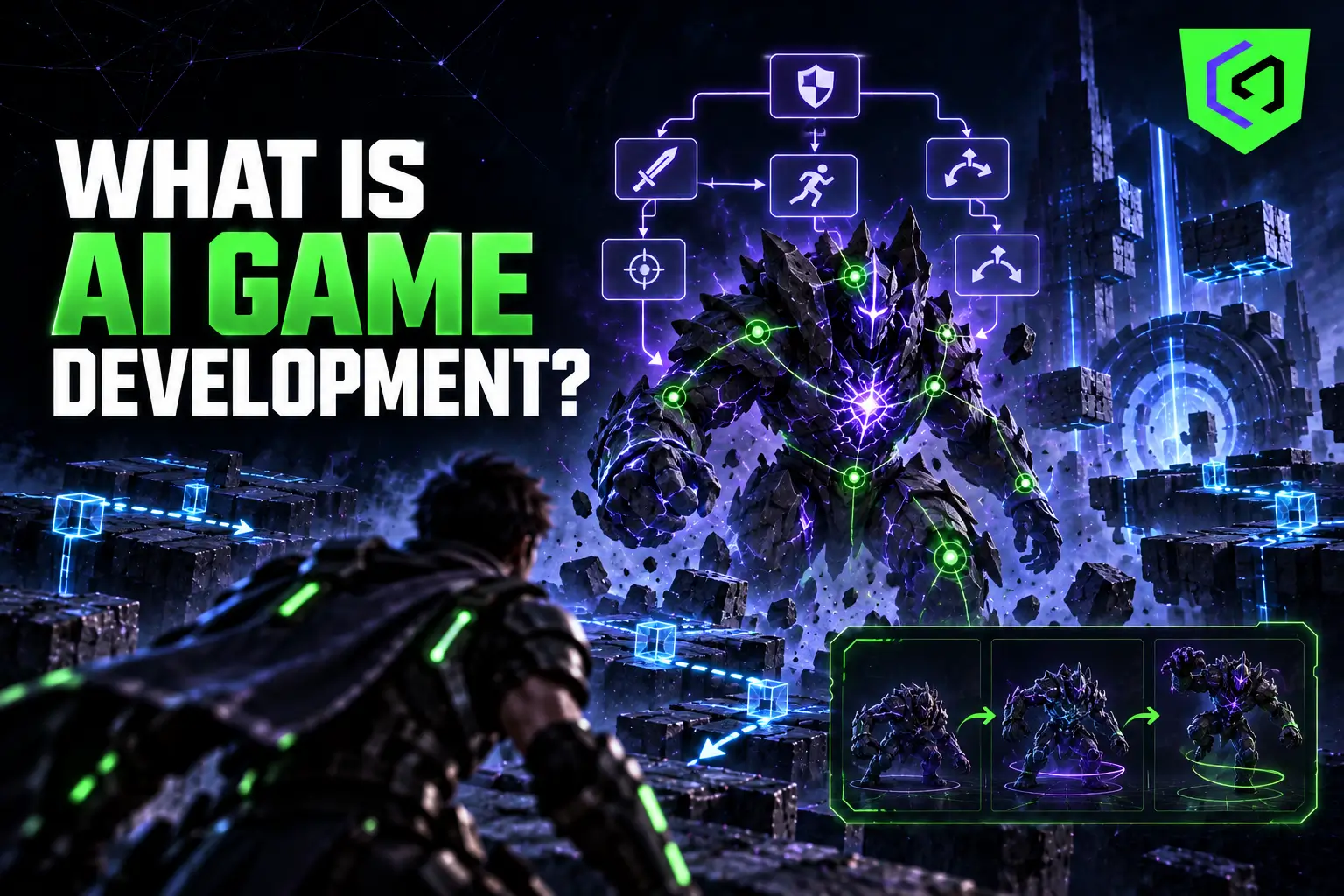
A boss that learns from how you play and stops falling for the same trick twice is not science fiction anymore; it is a production decision a studio made somewhere in pre-production, and decisions like that are exactly what this discipline actually covers.
The category has moved well past the marketing buzzword phase it sat in a few years ago. According to Research and Markets, the artificial intelligence games market is valued at 3.73 billion dollars in 2026 and is projected to reach 10.71 billion dollars by 2030, and the more telling number sits in Steam’s own disclosure data: games flagged as using generative AI made up roughly 11 percent of 2024 releases, climbed to about 20 percent in 2025, and have already reached over 30 percent of new releases so far in 2026. This guide breaks down what building this technology into a game actually involves, where it genuinely improves a game versus where it just pads a feature list, and what to know before bringing an AI game developer onto your project.
What Is AI Game Development?
AI game development is the practice of building artificial intelligence systems directly into a game’s design and code, covering everything from how non-player characters behave to how a level generates itself, how difficulty adjusts to a specific player, and how a studio tests a build before launch. It spans a collection of distinct techniques, some decades old and well understood, some genuinely new, all aimed at making a game feel more responsive, more replayable, or cheaper to produce at scale.
The term gets used loosely across the industry, which causes real confusion for studios trying to plan a budget around it. Classic pathfinding and decision-tree behavior for enemies has existed since the earliest 3D games and counts as artificial intelligence in games under any reasonable definition, while generative tools that produce art, dialogue, or code assistance are a much more recent addition to that same umbrella term. Both matter, but they solve completely different problems and require completely different skill sets to implement well.
Where AI Actually Shows Up Inside a Game?
NPC behavior is the most visible and longest-standing application of AI in gaming. Enemies that flank, retreat, coordinate with allies, or adapt their tactics based on player behavior all rely on decision trees, behavior trees, or increasingly on machine learning models trained to produce more organic-feeling responses than a hand-scripted state machine ever could. This is the category most people picture when they hear the term, and it remains the one with the clearest, most direct impact on how a game actually plays.
Procedural content generation uses algorithms to build levels, terrain, quests, or items dynamically rather than hand-placing every element, which lets a small team produce far more content variety than their headcount would otherwise allow. Adaptive difficulty systems monitor player performance in real time and adjust enemy strength, resource availability, or puzzle complexity to keep a specific player in their own zone of challenge, rather than forcing every player through the same fixed curve regardless of skill.
Testing and quality assurance represent a less glamorous but increasingly important application. AI-assisted testing tools can run thousands of automated playthroughs looking for crashes, exploits, or balance issues far faster than a human QA team could manually, which is reshaping how studios structure their testing budgets. Player behavior analytics round out the list, using AI models to identify patterns in how players actually engage with a game, informing everything from monetization tuning to where a level design is quietly losing player interest.
AI Game Developers Versus Traditional Game Developers: What Actually Changes?
An AI game developer needs the same foundational skills as any other engineer: solid systems architecture, engine proficiency, and an understanding of how gameplay code interacts with performance budgets, plus an additional layer of expertise in the specific AI techniques a project actually needs. That might mean deep familiarity with behavior trees and finite state machines for NPC work, or genuine machine learning experience for a studio building adaptive systems trained on real player data.
This distinction matters enormously when a studio starts hiring or outsourcing for this work, since the term covers such a wide skill range. A developer strong in classic scripted AI for enemy behavior is not automatically qualified to build a machine-learning-driven recommendation system for in-game economies, and treating those as interchangeable skill sets is one of the more common and expensive mistakes studios make when scoping work for AI game developers for the first time.
Generative AI Versus Applied Gameplay AI: Two Very Different Conversations
Generative AI in this context refers to tools that produce content directly, art assets, dialogue, code suggestions, or even full levels, based on prompts or training data. This is the category driving that Steam disclosure spike, and it is also the category attracting the most public debate, since it touches directly on questions of originality, labor, and quality control that studios have to navigate carefully regardless of how the underlying technology performs.
Applied gameplay AI, by contrast, refers to systems that make decisions during actual play: an enemy choosing a tactic, a difficulty system adjusting a spawn rate, a companion character reacting to a player’s choices. This category has existed in some form since the earliest games and generally attracts far less controversy, since it is judged purely on whether it makes the game more fun rather than on any of the broader questions surrounding generative content. Studios building out a broader AI strategy benefit enormously from keeping these two conversations separate, since they involve different technical approaches, different risks, and often completely different stakeholders inside a production.
What Do Intelligent Games Actually Feel Like to Play?
The best implementations of this technology are invisible in the sense that players rarely think consciously about “the AI”; they just notice that an encounter felt fair, that a companion character reacted appropriately to a story beat, or that a game seemed to understand when they needed an easier stretch after several difficult attempts at the same section. Intelligent games succeed by disappearing into the experience rather than announcing themselves as a feature.
The failures are usually more visible than the successes. Enemies that clearly cheat by seeing through walls, difficulty systems that swing so aggressively a player notices the game babying them, or generated content that repeats obvious patterns all break immersion in ways that a simpler, more predictable system often would not. This is the central design tension in the category: the goal is almost always to feel smart without feeling like a system, and that is a much harder bar to clear than raw technical sophistication alone.
How Does This Kind of Project Actually Get Built?
Most engagements start with a clear scope of what specific problem the AI system needs to solve, better enemy behavior, faster content production, smarter testing, rather than a vague mandate to “add AI” somewhere in the build. That specificity matters because the techniques, tools, and timelines differ enormously depending on which problem is actually being solved.
From there, a prototype typically gets built to test whether the chosen approach produces genuinely better results than the existing scripted or manual system it would replace, since AI systems can be expensive to build and are not automatically superior just because they are more technically sophisticated. Once a prototype proves its value, the system gets integrated into the broader production pipeline, tuned against real playtesting data, and refined through the same iterative process any other core game system goes through before launch. Cobweb Games builds this work as part of a broader 3d game development practice, treating AI systems as one tool among many rather than a separate specialty bolted onto a project after the fact.
How to Evaluate an AI Game Development Partner?
Ask for specific examples of the exact technique your project needs, not general AI familiarity. A studio that lists “AI experience” on a pitch deck without naming whether that means behavior trees, procedural generation, or trained machine learning models is asking you to take their competence on faith, and that is not a reasonable position to put a client in during a vendor evaluation.
Request a small proof-of-concept before committing to a full production scope, the same way a studio would pilot any other specialized discipline. A working prototype of the specific system, an enemy behaving more intelligently, a level generating cleanly, a difficulty curve responding to real playtest data, tells you far more about a partner’s actual capability than a portfolio of past client logos ever will. Studios that skip this step and commit directly to full-scope work tend to discover capability gaps only after real budget has already been spent, which is exactly the outcome a short proof-of-concept phase is designed to prevent.
What Makes This Technology a Genuine Improvement Rather Than a Gimmick
The systems that actually move the needle share one trait: they were built to solve a specific, testable player experience problem rather than added because the technology was available. A studio chasing a difficulty spike complaint in playtest feedback that builds an adaptive system to address it directly is using this technology correctly. A studio adding a generative NPC dialogue system because a competitor announced one, without first confirming players actually want that specific feature, is far more likely to end up with an expensive distraction than a genuine improvement.
This is ultimately a design discipline wearing a technical hat rather than a purely technical one. The best AI game developers on any project spend as much time in conversation with designers about what player experience problem they are actually solving as they do writing the underlying systems, and that collaboration is usually the clearest signal of whether a studio’s investment in this area will pay off inside the finished game.
Common Mistakes When Adding AI to a Game
Building the system before defining what problem it solves is the most common and costly mistake. A studio that commits budget to a machine-learning-driven NPC system without first confirming that scripted behavior trees genuinely cannot achieve the same result often ends up with an expensive, harder-to-debug version of something a simpler system would have handled just as well.
Treating every AI application the same way is another recurring issue, since generative content tools, adaptive gameplay systems, and testing automation all carry different risks, costs, and integration requirements. Skipping player testing on adaptive systems specifically causes real problems too, since a difficulty curve that looks mathematically sound on paper can still feel patronizing or unfair to an actual player, and that gap only shows up once real people are put in front of the build.
What Does AI Game Development Cost?
Pricing depends heavily on which category of work is involved. Scripted or behavior-tree-based NPC systems tend to cost roughly in line with standard gameplay programming work, since the underlying skill set overlaps significantly with general game development. Machine-learning-driven systems, whether for adaptive difficulty, procedural generation, or player behavior modeling, typically cost more due to the specialized expertise required and the additional testing and tuning cycles needed to get a trained model performing reliably inside a live game.
Studios should budget for iteration specifically, since AI systems rarely work correctly on the first pass the way a deterministic feature often does. A realistic budget accounts for several rounds of tuning against actual playtest data rather than assuming a single implementation phase will get a system production-ready.
Frequently Asked Questions
Do I need machine learning experience to build AI into my game?
Not always. Many of the most effective AI systems in games, especially NPC behavior and pathfinding, use classic techniques like behavior trees and finite state machines rather than machine learning. Genuine ML expertise becomes necessary specifically for systems trained on real data, like adaptive difficulty models or player behavior prediction.
Is generative AI content legally safe to use in a commercial game?
This depends heavily on the specific tool, its training data, and current platform policies, which continue to evolve. Studios should review the licensing terms of any generative tool carefully and stay current on platform disclosure requirements, since several major storefronts now require flagging AI-generated content explicitly.
How is AI game development different from general game development outsourcing?
The core production process is similar, discovery, prototyping, integration, and testing, but building artificial intelligence game features requires additional technical vetting to confirm a partner has genuine experience with the specific technique a project needs, whether that is behavior trees, procedural generation, or applied machine learning, rather than general gameplay programming experience alone.
Can AI game developers help with existing games, or only new projects?
Both. AI systems like adaptive difficulty or improved NPC behavior can often be integrated into an existing live game, though the scope of what is feasible depends heavily on how the original codebase was architected and how much refactoring a retrofit would require.
What is the difference between AI in gaming for NPCs versus AI used in game testing?
NPC-focused AI in gaming shapes what a player experiences directly during gameplay, while AI used in testing runs automated playthroughs behind the scenes to catch bugs, exploits, and balance issues before a build reaches players. Both fall under the same broad category but require different tools, different skill sets, and are evaluated against completely different success metrics.
Do intelligent games cost more to develop overall, or does AI save money in production?
It depends on the application. Procedural content generation and AI-assisted testing can meaningfully reduce production costs by automating work that would otherwise require large manual teams. Custom-trained gameplay AI systems, on the other hand, typically add cost upfront in exchange for a better player experience, rather than reducing the overall production budget.
Outsourcing Done Right Looks Like a Second Studio, Not a Vendor
The studios that get the most out of game art outsourcing stop treating it as a transaction and start treating it as an extension of their own team. That means a real brief, a real feedback loop, and a partner chosen for fit rather than the lowest quote on the page. Cobweb Games works as exactly that kind of extension, running as an integrated art department for studios that need production capacity without the overhead of building one internally.
