

That single range answers the question most people are searching for. But “how much does it cost to build an app” is the wrong question to ask, because the same app can cost $40,000 or $350,000 depending on decisions you make in the first two weeks. This guide breaks down every cost driver, gives you real 2026 hourly rates by region, walks through cost by app type and complexity, and exposes the hidden line items that quietly blow up budgets so you can walk into any quote with a number in your head that’s actually defensible.
Mobile App Development Cost at a Glance (2026)
If you only read one section, read this one.
| App complexity | Typical cost range (2026) | Example | Rough timeline |
|---|---|---|---|
| Simple | $15,000 – $50,000 | Single-purpose tool, MVP, static content app, basic loyalty/scanner app | 3 – 4 weeks |
| Medium | $50,000 – $120,000 | SaaS mobile client, on-demand service app, social app with backend | 3 – 6 months |
| Complex | $120,000 – $300,000+ | Marketplace, fintech, healthcare platform, real-time or AI-powered app | 6 – 10+ months |
Industry data compiled across thousands of projects places the average custom mobile app at roughly $171,000, though that figure is pulled upward by large enterprise builds. The realistic center of gravity for most businesses sits in the $50,000–$120,000 band.
These numbers cover the build. They do not include ongoing maintenance, marketing, or app store fees, all of which we cover further down so you see the true total cost of ownership, not just the sticker price.
How App Development Cost Is Actually Calculated
Almost every honest quote in the industry comes down to one formula:
App development cost = Total development hours × Hourly rate
A development company that charges $40/hour for a project that takes 2,500 hours arrives at $100,000, before maintenance and updates. Change either variable and the whole budget moves.
That’s why two agencies can quote wildly different numbers for “the same app.” One may be quoting a leaner feature set at a higher senior rate; another may be quoting a bloated scope at a cheaper junior rate. Same headline app, very different math, and very different outcomes.
There’s a second, slower lever most first-time buyers miss: a senior team at $150/hour that ships in 16 weeks can cost exactly the same as a junior team at $50/hour that takes 48 weeks, except the senior team’s code is usually cheaper to maintain afterward. Hourly rate alone tells you almost nothing. Hours-to-ship and code quality are where the real cost lives.
This is the single most important mental model in this entire guide: you are not buying hours, you are buying a shipped, maintainable product. Cheap hours that produce technical debt are the most expensive hours you can buy.
Cost by App Complexity: Simple, Medium, Complex
“Complexity” isn’t a vibe — it’s a measurable function of features, screens, integrations, and backend logic. Here’s what each tier actually means.
A simple app costs $15,000–$50,000, a medium app $50,000–$120,000, and a complex app $120,000–$300,000+. Complexity is measured by feature count, backend logic, integrations, and compliance requirements, not by app size.
Simple Apps: $15,000 to $50,000
Single-purpose tools, MVPs, and companion apps for an existing product. Think a static event guide, a basic loyalty-card scanner, or a content app. The UI is narrow (a handful of reusable component types), and the backend is often offloaded entirely to a Backend-as-a-Service like Firebase, which removes server costs at this stage.
Typical features: user login, a few static or feed-style screens, basic push notifications, simple analytics.
Medium Apps: $50,000 to $120,000
This is where most commercial apps live. A SaaS mobile client (the mobile front-end for an existing web platform) is the archetype. You’re now funding a real backend, API integrations, custom UI, and a proper QA cycle.
Typical features: custom user accounts and roles, payment integration, real-time data, third-party APIs (maps, messaging), an admin panel, offline support.
Complex Apps: $120,000 to $300,000+
Marketplaces, fintech platforms, healthcare apps, and anything with real-time infrastructure, heavy compliance, or AI. These are multi-sided systems with sophisticated backends, scaling requirements, and regulatory cost baked in.
Typical features: multi-user roles, real-time tracking or messaging at scale, complex payment flows, advanced security and compliance (HIPAA, PCI-DSS), AI/ML features, multiple third-party integrations.
Cost by App Type (With Real Examples)
The clearest way to anchor a budget is to look at what comparable apps cost to build. Ranges below reflect 2026 market data for a production-grade build (not a bare clone).
| App type | Typical 2026 cost range | What drives the cost |
|---|---|---|
| MVP / proof of concept | $15,000 – $40,000 | Core feature only, minimal design, fast validation |
| eCommerce app | $50,000 – $150,000 | Catalog, cart, payments, order management |
| On-demand / ride-hailing (Uber-like) | $50,000 – $300,000+ | Real-time tracking, dual apps, dispatch, payments |
| Food delivery (DoorDash-like) | $50,000 – $200,000 | Multi-vendor, live tracking, three user types |
| Fintech / mobile banking | $100,000 – $300,000+ | Security, compliance (PCI/KYC), integrations |
| Healthcare / telemedicine | $70,000 – $250,000+ | HIPAA compliance, video, EHR integration |
| Social media app | $60,000 – $250,000 | Real-time feeds, media handling, scale |
| AI-powered app | $40,000 – $300,000+ | LLM/model integration, data pipelines |
A note on the “cost to build an app like X” question, which is one of the most common searches in this space: real-time, multi-sided apps (ride-hailing, delivery) are expensive because you’re effectively building two or three apps (customer, provider, admin) plus the live infrastructure that connects them. Integrating generative AI or agentic workflows typically adds a 20%–50% premium, with an extra $15,000–$80,000 for LLM integration, vector databases, and the surrounding plumbing.
Developer Hourly Rates by Region in 2026
Location is the single biggest lever on your hourly rate, and therefore on your total cost. Here’s the verified 2026 picture.
| Region | Typical agency hourly rate (2026) |
|---|---|
| North America (US, Canada) | $100 – $250/hr |
| Western Europe (UK, Germany) | $80 – $150/hr |
| Eastern Europe (Poland, Ukraine) | $45 – $80/hr |
| South Asia (India) | $20 – $50/hr |
Source: Business of Apps
According to Clutch, the B2B ratings platform, the operating system you choose (iOS vs. Android) does not change the hourly rate — developers charge roughly the same either way. What does double your cost is building two separate native apps instead of one shared codebase.
Outsourcing to lower-cost regions can cut total project cost by 40%–70% versus a US-based team. But the GoodFirms survey is blunt about the catch: cheap hourly rates only translate to savings when the spec is airtight and someone senior owns architecture and review. The cheapest hour is frequently the most expensive outcome.
The 7 Factors That Move Your Budget the Most
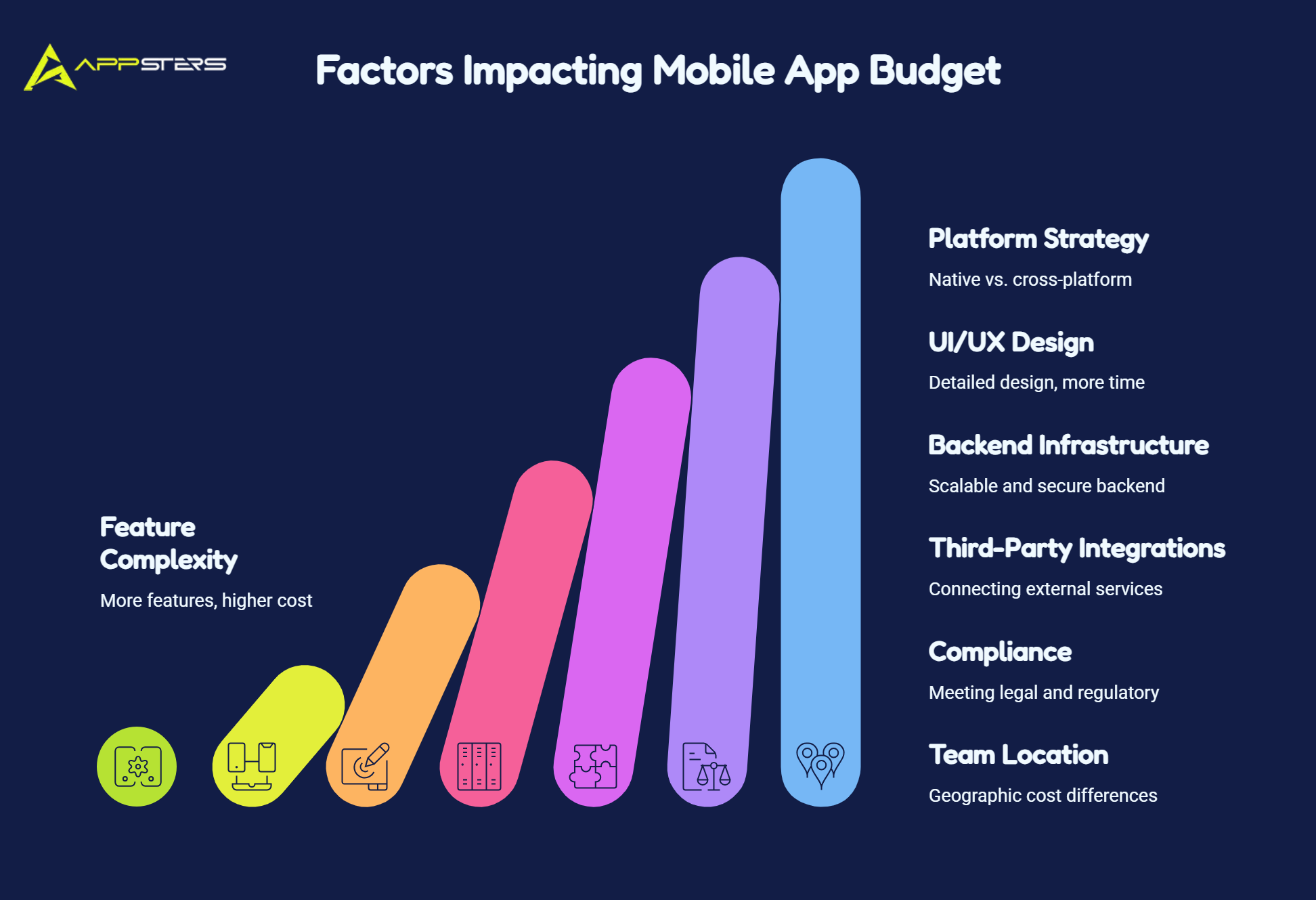
Every quote is the sum of these seven variables. Understanding them is how you separate a fair quote from an inflated one.
- Feature complexity. Each meaningful feature adds engineering and QA hours. A Stripe payment integration with webhook handling adds roughly 20–40 hours; a custom real-time geolocation feature adds 80–150 hours depending on accuracy.
- Platform strategy. One cross-platform app, two native apps, or native plus web. Two native codebases run roughly 30%–40% higher than a shared codebase for the same feature set.
- UI/UX design depth. Template vs. custom design carries a $30,000–$100,000 spread. Design typically accounts for 15%–25% of a moderate build, and cutting it usually shows up as churn within 90 days, not savings.
- Backend and infrastructure. The “brains” of the app: servers, databases, APIs, cloud. The more real-time and data-heavy your app, the higher this line.
- Third-party integrations. Every payment gateway, mapping service, CRM, or identity-verification provider adds engineering, testing, and ongoing maintenance overhead.
- Compliance. HIPAA, PCI-DSS, GDPR, and emerging AI-governance rules aren’t optional engineering choices — they’re fixed costs determined by your industry and markets.
- Team location and seniority. As covered above, this sets your hourly rate and, indirectly, your code quality and maintenance bill.
Native vs. Cross-Platform: The Cost Trade-Off
This one decision can swing your budget by tens of thousands of dollars, so it deserves its own section.
Cross-platform development (Flutter, React Native) costs 30–45% less than building separate native iOS and Android apps, because it shares one codebase. Native is worth the premium only for performance-critical or hardware-heavy apps.
Native development (Swift/SwiftUI for iOS, Kotlin/Jetpack Compose for Android) gives the highest performance ceiling and the deepest access to device features, but you’re funding two parallel codebases. For a moderately complex app, that’s roughly 30%–40% higher cost, with engineering hours scaling from ~2,500 to ~4,000 for the same feature set.
Cross-platform development (React Native, Flutter) uses a single codebase across iOS and Android and cuts cost by 30%–45%, delivering 30%–40% faster than dual-native builds.
| Factor | Native | Cross-platform |
|---|---|---|
| Relative cost | Higher (two codebases) | 30–45% lower (one codebase) |
| Performance | Highest | Near-native |
| Best for | Hardware-heavy, performance-critical apps | MVPs, most consumer & business apps |
| Time to market | Slower | 30–40% faster |
The pragmatic 2026 default for most businesses is cross-platform, reserving native for the specific cases that genuinely need it.
The Hidden Costs Nobody Quotes You
This is where budgets quietly bleed. Hidden and recurring costs can account for 25%–35% of total project cost. Budget for them up front.
App store fees (verified, 2026):
- Apple Developer Program: $99/year, billed annually, required to keep your app live.
- Google Play Console: $25, one-time, lifetime, no renewal.
- Commissions: Apple takes 15%–30% on in-app purchases (15% under the Small Business Program for developers under $1M/year); Google takes 15% on the first $1M/year, then 30% above.
Quality assurance. QA runs at 20%–25% of total development hours. At a blended agency rate, that alone can mean $10,000–$37,500 on a moderate build — a line item that surprises most first-time buyers.
Other commonly missed costs: third-party API and SDK subscription fees, cloud hosting that scales with users, device testing (real teams keep a drawer of phones), payment-processing fees, localization (~$200–$500 per language for store assets), and ongoing security/compliance work.
I am text block. Click edit button to change this text. Lorem ipsum dolor sit amet, consectetur adipiscing elit. Ut elit tellus, luctus nec ullamcorper mattis, pulvinar dapibus leo.
Cost Breakdown by Development Phase
A useful way to sanity-check any quote is to see how the total splits across phases. A widely used industry breakdown looks like this:
| Phase | Share of build cost | What happens here |
|---|---|---|
| Discovery & planning | ~10% | Research, scoping, requirements, architecture |
| UI/UX design | ~15% | Wireframes, prototypes, design system, handoff |
| Development | ~50% | Frontend, backend, integrations, core build |
| QA & testing | ~15% | Functional, performance, security, device testing |
| Deployment & launch | ~10% | Store submission, release, launch setup |
If a quote allocates almost nothing to discovery or QA, treat that as a red flag, not a saving. Roughly 70% of large digital programs miss their targets for cost, schedule, or value, and the usual culprit is weak planning, not weak code.
Ongoing Costs After Launch
App development is not a one-time purchase. Plan for 15%–25% of the initial build cost, per year, in ongoing maintenance from year one onward.
That recurring spend covers bug fixes, OS-compatibility updates (Apple and Google ship breaking changes regularly), security patches, server and hosting scaling, third-party subscription renewals, and the feature improvements that keep users from churning. An app that launches and then goes untouched degrades fast: stores hide or remove outdated apps, and policy updates roll out frequently.
How to Reduce App Development Cost (Without Cutting Corners)
There’s a right way and a wrong way to spend less. The wrong way (cheapest possible hours, skipped QA) costs more later. Here’s the right way, drawn from what consistently works:
- Start with an MVP. Build the core feature that proves the idea, launch, learn from real users, then expand. A phased build can save up to 40% versus front-loading every feature on day one.
- Go cross-platform unless you have a specific reason not to (30%–45% saving).
- Lock the scope before you build. Scope creep is the most expensive habit in software. A tight requirements document prevents costly rebuilds.
- Use a reputable nearshore/offshore partner with senior oversight, not the cheapest available rate.
- Don’t cut design or QA. These are the two areas where “saving” reliably becomes churn and rework.
- Use modern AI-assisted tooling where it genuinely speeds delivery — used well, it’s contributing to faster builds across the industry.
The goal isn’t to spend the least. It’s to spend the right amount on the things that determine whether your app survives its first year.
The Bottom Line
In 2026, expect to spend $15,000–$50,000 for a simple app, $50,000–$120,000 for a medium app, and $120,000–$300,000+ for a complex one, plus 15%–25% of that annually to keep it healthy. The exact figure is set by your feature scope, platform choice, design depth, and the team you hire.
The smartest money in app development isn’t the cheapest — it’s the budget that’s matched honestly to scope and protected from scope creep, weak planning, and skipped QA. Get those right and the headline number takes care of itself.
If you’re scoping a build and want a realistic, transparent estimate for your feature set, our team works through exactly this math with founders and product owners every week as a mobile app development company — bring your idea, and we’ll help you pressure-test the number.
Frequently Asked Questions
Q: How much does it cost to develop a mobile app in 2026?
Mobile app development costs $15,000–$50,000 for a simple app, $50,000–$120,000 for a medium app, and $120,000–$300,000+ for a complex app. Most business apps land in the $50,000–$120,000 range. The two biggest variables are feature complexity and developer hourly rate.
Q: Is it cheaper to build an iOS or Android app?
Neither — developers charge roughly the same hourly rate for both platforms (Clutch). What raises the cost is building two separate native apps instead of one cross-platform app, which can run 30%–40% more.
Q: How much does it cost to maintain an app per year?
Budget 15%–25% of your initial build cost annually for maintenance, covering OS updates, security patches, hosting, and feature work.
Q: Why are app development quotes so different from each other?
Because cost = hours × rate, and both vary enormously. A cheaper hourly rate often hides a junior team, a longer timeline, or skipped QA, which raises the true total cost of ownership.
How can I reduce my app development cost?
Start with an MVP, choose cross-platform, lock your scope before building, and never cut design or QA. A phased, MVP-first approach can save up to 40%.
Q: What are the hidden costs of building an app?
App store fees ($99/year Apple, $25 once for Google), 15–30% in-app purchase commissions, QA (20–25% of dev hours), hosting, third-party subscriptions, device testing, and ongoing compliance. These add 25–35% on top of the build.